

Education Creatively Done
Here is a digest of articles and videos to be a resource bank in informing public awareness and future directions for UK education. Do please send in your suggestions - see details at foot of this page.
20C Pioneers of Insight and Practice
-
INTRODUCTION
20th Century Pioneers of Insight & Practice
Click on individual tabs to go to the content.
-
FRIEDRICH FROEBEL
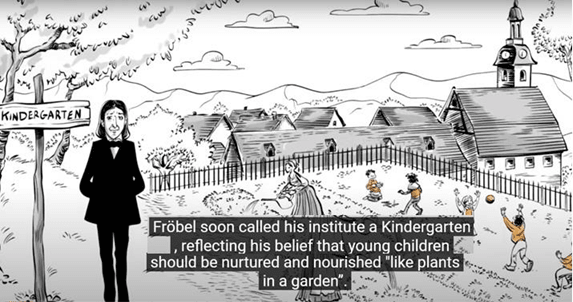
Born on 21 April 1782, Friedrich Froebel was a German educator who invented the kindergarten. He believed that “play is the highest expression of human development in childhood for it alone is the free expression of what is in the child’s soul.” According to Froebel, in play children construct their understanding of the world through direct experience with it. His ideas about learning through nature and the importance of play have spread throughout the world.
Froebel considered the whole child’s, health, physical development, the environment, emotional well-being, mental ability, social relationships and spiritual aspects of development as important. Drawing on his mathematical and scientific knowledge Froebel developed a set of gifts (wooden blocks 1-6) and introduced occupations, (including sticks, clay, sand, slates, chalk, wax, shells, stones, scissors, paper folding). It seems appropriate to mention Froebel’s gifts and occupations in conjunction with this new course. Particularly as the gifts and occupations are open-ended and can be used to support children’s self initiated play.Froebel believed that it was important for practitioners to understand the principles of observation including professional practice, the multiple lenses through which they see children- and that children see their worlds, as well as offering children freedom with guidance and considering the children’s environments including people and materials as a key element of how they behave.
Because Froebel based much of his understanding of children on observing them this has changed the way we think about children’s play.
We have Froebel’s insights to thank for placing child initiated activity with adults working with children to give them freedom with sensitive guidance and symbolic and imaginative play at the heart of our curriculum.
Principles
Froebelian principles as articulated by Professor Tina Bruce (1987, 1st edition and 2015, 5th edition).- Childhood is seen as valid in it self, as part of life and not simply as preparation for adulthood. Thus education is seen similarly as something of the present and not just preparation and training for later.
- The whole child is considered to be important. Health – physical and mental is emphasised, as well as the importance of feelings and thinking and spiritual aspects.
- Learning is not compartmentalised, for everything links.
- Intrinsic motivation, resulting in child-initiated, self directed activity, is valued.
- Self- discipline is emphasised.
- There are specially receptive periods of learning at different stages of development.
- What children can do (rather than what they cannot do) is the starting point in the child’s education.
- There is an inner life in the child, which emerges especially under favourable conditions.
- The people (both adults and children) with whom the child interacts are of central importance.
- Quality education is about three things: the child, the context in which learning takes place, and the knowledge and understanding which the child develops and learns.
-
SUSAN ISAACS
The aim of education is to create people who are not only self-disciplined and free in spirit, gifted in work and enjoyment, worthy and desirable as persons, but also responsible and generous in social life, able to give and take freely from others, willing to serve social ends and to lose themselves in social purposes greater than themselves.
Susan Isaacs in 'Susan Isaacs, The First Biography': Dorothy Gardener (1969 Methuen)
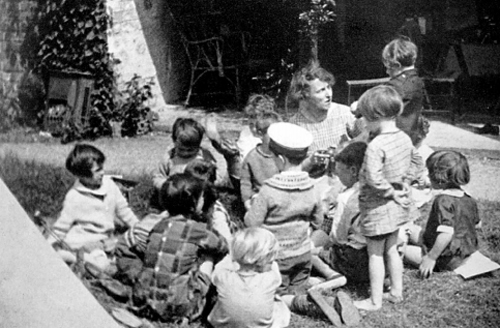
One of the early exponents of play, and open air play in particular, was a psychologist called Susan Isaacs (1885-1948), amongst whose many initiatives was the Chelsea Open Air Nursery, which she founded in 1928.
Isaacs argued that children’s play was a form of self-expression that enabled them both to release their real feelings safely and to rehearse ways of dealing with a range of emotions. She also emphasised the importance of social interaction within play.
Isaac developed these theories through the observation of children whilst head of an experimental school in Cambridge called Maltings House between 1924 and 1927, just prior to the opening of her Open Air Nursery.
The school included plenty of garden space and equipment with which the children could explore the physical world, the ways things are made, and the manner in which they break apart!
Isaacs was a leading member of the Nursery School Association (now known as Early Education - The British Association for Early Childhood Education) which campaigned for recognition of the benefits of early education. She was also the instigator of the British Psychological Society Committee for Research in Education from 1923 and in 1931 Chairman of the BPS Education Section.
Her interest in child and educational development was not confined to the pre-school age group – she also observed and made recommendations for older children (Isaacs, The Primary School, 1931), and her later work as Director of the newly established Department of Child Development at the Institute of Education in London included the early development of child guidance clinics. In 1936 Isaacs recommended that a dedicated playroom should be included in the clinics (Isaacs, Child Guidance. Suggestions for a Clinic Playroom, 1936).
Throughout her career, Isaacs remained committed to engaging directly with the public. Her book on nursery education sold 100, 000 copies (an anniversary edition was reprinted in 2013), and she wrote for parents in popular magazines such as “Parents’ Review”, “Mind, Mother and Child”,” Home and School” and” New Era”.
Source: The British Psychological Society https://www.bps.org.uk/blogs/history-psychology-centre/right-play-covid-19-and-lessons-history
Free PDF - The Educational Value of the Nursery School by Susan Isaacs (1937)
Discussion Article: Does Early Childhood Education in England for the 2020s Need to Rediscover Susan Isaacs: Child of the Late Victorian Age and Pioneering Educational Thinker?
by Professor Philip Hood, Nottingham Uni: https://www.mdpi.com/2313-5778/3/3/39/htm -
JOHN DEWEY
Education is not a preparation for life, it is life itself.
 John Dewey was a pragmatist, progressivist, educator, philosopher, and social reformer (Gutek, 2014). Dewey’s various roles greatly impacted education, and he was perhaps one of the most influential educational philosophers known to date (Theobald, 2009). Dewey’s influence on
education was evident in his theory about social learning; he believed that school should be representative of a social environment and that students learn best when in natural social settings (Flinders & Thornton, 2013). His ideas impacted education in another facet because he believed that students were all unique learners. He was a proponent of student interests driving teacher instruction (Dewey, 1938).With the current educational focus in the United States being on the implementation of the Common Core standards and passing standardized tests and state exams, finding evidence of John Dewey’s theories in classrooms today can be problematic (Theobald, 2009). Education in most classrooms today is what Dewey would have described as a traditional classroom setting. He believed that traditional classroom settings were not developmentally appropriate for young learners (Dewey, 1938). Although schools, classrooms, and programs that support Dewey’s theories are harder to find in this era of testing, there are some that still do exist.
Paper: John Dewey in the 21st Century Morgan K. Williams University of West Florida
https://files.eric.ed.gov/fulltext/EJ1158258.pdf15 John Dewey Quotes On Education, Experience, And Teaching
by TeachThought Staff
John Dewey (1859-1952) was an influential American philosopher, psychologist, and educational reformer who worked to help develop the concept of pragmatism, a philosophical perspective emphasizing the practical consequences of ideas.
Who was John Dewey?
Considered one of the founders of modern publication in the United States, his work had a significant impact on education, promoting the idea that learning should be experiential and focused on problem-solving rather than rote memorization.
He believed in the importance of democratic values and advocated for education that fosters active citizenship and social progress. Dewey’s ideas continue to shape modern educational theory and practice, and his contributions extend to various fields, including psychology, ethics, and political philosophy.
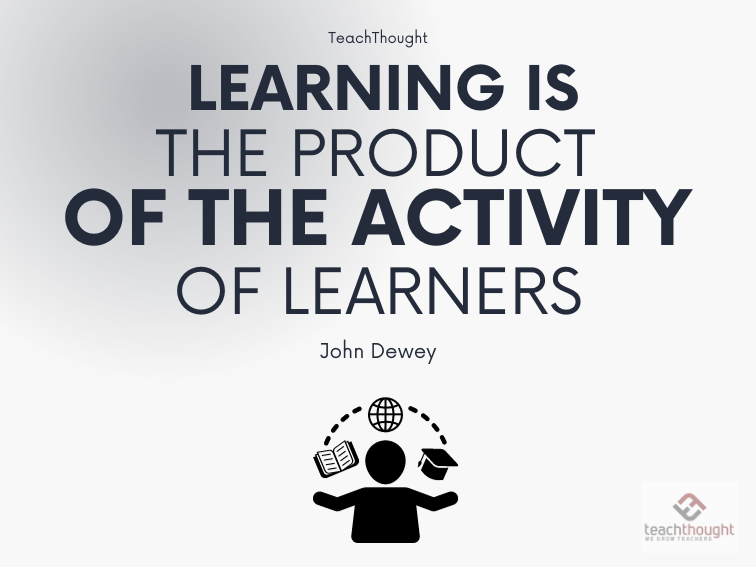
John Dewey Quotes On Education, Experience, And Teaching
“I believe that the only true education comes through the stimulation of the child’s powers by the demands of the social situations in which he finds himself.”
“I believe that this educational process has two sides – one psychological and one sociological; and that neither can be subordinated to the other or neglected without evil results following.”
“Education is not preparation for life; education is life itself.”
“We do not learn from experience… we learn from reflecting on experience.”
“The self is not something ready-made, but something in continuous formation through choice of action.”
“Failure is instructive. The person who really thinks learns quite as much from his failures as from his successes.”
“Give the pupils something to do, not something to learn; and the doing is of such a nature as to demand thinking; learning naturally results.”
“Society not only continues to exist by transmission, by communication, but it may fairly be said to exist in transmission, in communication.”
“Interest in the subject at hand is the best stimulus for learning.”
“The aim of education is to enable individuals to continue their education.”
“Education is a social process; education is growth; education is not a preparation for life but is life itself.”
“If we teach today’s students as we taught yesterday’s, we rob them of tomorrow.”
“Every great advance in science has issued from a new audacity of imagination.”
“Learning is not the product of teaching. Learning is the product of the activity of learners.”
“The only freedom that is of enduring importance is the freedom of intelligence, that is to say, freedom of observation and of judgment.”
“The good man is the man who, no matter how morally unworthy he has been, is moving to become better.”
“The teacher is not in the school to impose certain ideas or to form certain habits in the child, but is there as a member of the community to select the influences which shall affect the child and to assist him in properly responding to these influences.”
“We must also be able to project them into the future to see what their outcome and end will be.”
“Education, therefore, must begin with a psychological insight into the child’s capacities, interests, and habits. It must be controlled at every point by reference to these same considerations. These powers, interests, and habits must be continually interpreted – we must know what they mean. They must be translated into terms of their social equivalents – into terms of what they are capable of in the way of social service.”
The Readmore link is to a short video by Youtube Sprouts Channel.
-
CHARLOTTE MASON
 A British educator and philosopher in the late 19th and early 20th century, Charlotte Mason (1842-1923) designed, developed, and promoted a relational education in a living environment filled with books, experiences, nature, and ideas, where the child is viewed as a person and the educator as one who cooperates with God.
After more than a dozen years of teaching children in the British school system in Worthing, UK, and then four years teaching adults in a new teacher education program in Chichester, UK, Mason gave a pivotal series of “Lectures to Ladies” in Bradford, UK during the winter of 1885 and 1886.
The seven-lecture series had such resonance that over the succeeding seven years, Charlotte Mason was at the heart of founding and launching a parent’s union, a teacher’s college, an educator’s journal, and a curriculum. A network of parents, educators, student teachers and governesses, community activists, writers, and schools were organized—organic, structured, connected organizations, institutions, and individuals all around a new guiding and developing philosophy of education led by Mason herself.As she promoted the idea that “education is an atmosphere, a discipline, and a life,” Mason summarized her educational philosophy into twenty principles drawn from her observations of children during years of teaching, the science of her day, and, most importantly, from the “code of education” she found in the gospels. (Source)
Here are her 'twenty principles of education' - you can read her book online from the Gutenberg Library:
1. Children are born persons.
2. They are not born either good or bad, but with possibilities for good and for evil.
3. The principles of authority on the one hand, and of obedience on the other, are natural, necessary and fundamental; but—
4. These principles are limited by the respect due to the personality of children, which must not be encroached upon, whether by the direct use of fear or love, suggestion or influence, or by undue play upon any one natural desire.
5. Therefore, we are limited to three educational instruments—the atmosphere of environment, the discipline of habit, and the presentation of living ideas. The P.N.E.U. Motto is: "Education is an atmosphere, a discipline, and a life."
6. When we say that "education is an atmosphere," we do not mean that a child should be isolated in what may be called a 'child-environment' especially adapted and prepared, but that we should take into account the educational value of his natural home atmosphere, both as regards persons and things, and should let him live freely among his proper conditions. It stultifies a child to bring down his world to the 'child's' level.
7. By "education is a discipline," we mean the discipline of habits, formed definitely and thoughtfully, whether habits of mind or body. Physiologists tell us of the adaptation of brain structures to habitual lines of thought, i.e., to our habits.
8. In saying that "education is a life," the need of intellectual and moral as well as of physical sustenance is implied. The mind feeds on ideas, and therefore children should have a generous curriculum.
9. We hold that the child's mind is no mere sac to hold ideas; but is rather, if the figure may be allowed, a spiritual organism, with an appetite for all knowledge. This is its proper diet, with which it is prepared to deal; and which it can digest and assimilate as the body does food-stuffs.
10. Such a doctrine as e.g. the Herbartian, that the mind is a receptacle, lays the stress of Education (the preparation of knowledge in enticing morsels duly ordered) upon the teacher. Children taught on this principle are in danger of receiving much teaching with little knowledge; and the teacher's axiom is "what a child learns matters less than how he learns it."
11. But we, believing that the normal child has powers of mind which fit him to deal with all knowledge proper to him, give him a full and generous curriculum; taking care only that all knowledge offered him is vital, that is, that facts are not presented without their informing ideas. Out of this conception comes our principle that,—
12. "Education is the Science of Relations"; that is, that a child has natural relations with a vast number of things and thoughts: so we train him upon physical exercises, nature lore, handicrafts, science and art, and upon many living books, for we know that our business is not to teach him all about anything, but to help him to make valid as many as may be of—
"Those first-born affinitiesThat fit our new existence to existing things."
13. In devising a Syllabus for a normal child, of whatever social class, three points must be considered:—
(a) He requires much knowledge, for the mind needs sufficient food as much as does the body.
(b) The knowledge should be various, for sameness in mental diet does not create appetite (i.e., curiosity).
(c) Knowledge should be communicated in well-chosen language, because his attention responds naturally to what is conveyed in literary form.
14. As knowledge is not assimilated until it is reproduced, children should 'tell back' after a single reading or hearing: or should write on some part of what they have read.
15. A single reading is insisted on, because children have naturally great power of attention; but this force is dissipated by the re-reading of passages, and also, by questioning, summarising, and the like.
Acting upon these and some other points in the behaviour of mind, we find that the educability of children is enormously[xxxi] greater than has hitherto been supposed, and is but little dependent on such circumstances as heredity and environment.
Nor is the accuracy of this statement limited to clever children or to children of the educated classes: thousands of children in Elementary Schools respond freely to this method, which is based on the behaviour of mind.
16. There are two guides to moral and intellectual self-management to offer to children, which we may call 'the way of the will' and 'the way of the reason.'
17. The way of the will: Children should be taught, (a) to distinguish between 'I want' and 'I will.' (b) That the way to will effectively is to turn our thoughts from that which we desire but do not will. (c) That the best way to turn our thoughts is to think of or do some quite different thing, entertaining or interesting. (d) That after a little rest in this way, the will returns to its work with new vigour. (This adjunct of the will is familiar to us as diversion, whose office it is to ease us for a time from will effort, that we may 'will' again with added power. The use of suggestion as an aid to the will is to be deprecated, as tending to stultify and stereotype character. It would seem that spontaneity is a condition of development, and that human nature needs the discipline of failure as well as of success.)
18. The way of reason: We teach children, too, not to 'lean (too confidently) to their own understanding'; because the function of reason is to give logical demonstration (a) of mathematical truth, (b) of an initial idea, accepted by the will. In the former case, reason is, practically, an infallible guide, but in the latter, it is not always a safe one; for, whether that idea be right or wrong, reason will confirm it by irrefragable proofs.
19. Therefore, children should be taught, as they become mature enough to understand such teaching, that the chief responsibility which rests on them as persons is the acceptance or rejection of ideas. To help them in this choice we give them principles of conduct, and a wide range of the knowledge fitted to them. These principles should save children from some of the loose thinking and heedless action which cause most of us to live at a lower level than we need.
20. We allow no separation to grow up between the intellectual and 'spiritual' life of children, but teach them that the Divine Spirit has constant access to their spirits, and is their continual Helper in all the interests, duties and joys of life.
'Towards a Philosophy of Education' Charlotte Mason 1925:
https://www.gutenberg.org/files/66369/66369-h/66369-h.htm#Page_xxv
Conservative Counter-voices & influences
-
INTRODUCTION
Conservative Counter-voices & influences
Click on individual tabs to go to the content.
-
DOMINIC CUMMINGS' 2013 paper on education
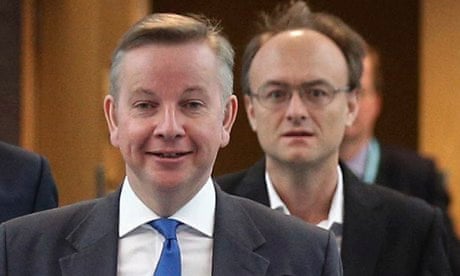
Dominic Cummings was a special adviser on policy to the then education secretary, Michael Gove.
In this document he discusses everything from maths, IQ and quantum computers to what is wrong with MPs, Whitehall and education policy. The section on education (pages 62-83) is probably the most controversial and political.
In one of the most controversial passages of the thesis, Cummings maintains that individual child performance is mainly based on genetics and a child's IQ rather than the quality of teaching.
He denies his views are embarrassing for either Gove or the government, but says he wants to see an attempt to build in a more scientific way to develop a more ambitious education and training system.
But his views on genetics, government inefficiency, the examination system and the quality of teaching will confirm the worst fears of some in the education system about the underlying direction of Gove's reforms.
Cummings is highly critical of the quality of teaching, writing: "While some children will always be blessed by a brilliant teacher, by definition that is not a scaleable solution to our problems: real talent is rare and mediocrity is ubiquitous."
source - The Guardian Oct 2013
-
EDUCATIONAL AMNESIA: A SUITABLE CASE FOR TREATMENT
Mary Jane Drummond 2004
The trouble started back in 1987. Without invoking a golden age, or glorifying the mythical Plowden years, in the years before the Education Reform Act of 1988, by and large, teachers did their own thinking, turning to a variety of sources to enrich their understanding and help them make a case for their principled pedagogical decisions.
But soon after the arrival of the DES National Curriculum consultation document, and the opening of the flood-gates to a never-ending stream of official publications, the first signs of professional amnesia appeared in our midst. Slowly but surely the early years community, and our colleagues higher up the primary school, began to act as if professional knowledge were only to be found in ring folders, of all degrees of glossiness; these were soon supplemented by training packs with videos and all manner of other pronouncements from authoritative bodies.
For a while, those of us working with children below the age of statutory education (which is five-and-a-bit, it’s always worth saying again, not four years old) enjoyed a false sense of security, we believed the structures of the National Curriculum and its associated testing procedures had no force where we were concerned ...
originally in primary education magazine Forum 2004, reprinted in ReFocus - see link
Possible Futures Today: Early Childhood Education
-
INTRODUCTION
Possible Futures Today: Early Childhood Education
Click on individual tabs to go to the content.
-
Leading Contemporary International Policies
A Trans-national Selection of National/State/International Contemporary Early Childhood Education founded on principles of children’s rights and capacities. (2022)
-
REALISING THE AMBITION: BEING ME - Education Scotland
Extract
What is the early childhood curriculum? The early childhood curriculum is holistic. It values children, recognising them as full of potential from birth. Our role in developing a flexible, enabling and creative child-centred curriculum is to be responsive to the uniqueness of each child, their family and the context of the community in which they live.
The world in which we live expects our children to be competent, capable individuals who learn and achieve well. Families are central to the child’s learning at home and in their community, to their acquisition of skills, capacities and attributes. Therefore, it is essential that as practitioners we develop strong links with parents in shaping the curriculum. Strong collaboration between practitioners, teachers and partners is also important in designing a continuous curriculum experience for babies and children as they journey from one phase of their education and care to another.
We know how babies and children learn best. They learn best in an environment of quality interactions, interesting spaces and when the experiences on offer are set in meaningful contexts. They learn best in environments that inspire them to be curious and creative.
The early childhood curriculum is also about what the child wants to learn within a caring, nurturing environment. While the intentional promotion of specific experiences and interactions are important for young children to learn, so too is a curriculum which values and upholds the rights of the child. The right to a relevant, coherent and child-centred curriculum which recognises and intends to build on what the child already knows. These intentions must be supported by high quality interactions and warm caring relationships. Relationships which are well judged and focussed on extending and deepening children’s skills as lifelong learners.
In the book “The Child’s Curriculum: working with the natural values of young children”, the authors suggest the principles of early childhood and care are advanced in a curriculum which; gives professional and expert attention to children’s developing sense of self and how their actions influence the world around them (which could be described as their agency), and interests.
Where guided pedagogy supports children’s interests and curiosity for learning. And, the recognition that meaningful social relationships and involvement of parents and community in the child’s learning are promoted to bring about long-term economic and health benefits. (Trevarthen et al., 2018: 314*)
We know from research and practice that the learning experiences provided in the earliest months and years in the child’s life are so critical for their future success in life. As already mentioned, the early childhood curriculum experiences that practitioners provide for our very youngest should continue to be based on the four interrelated and interdependent principles of the Rights of the Child, Relationships, Responsive Care and Respect.
[*Trevarthen, C. (2018) What young children give to their learning. In The child’s curriculum: working with the natural values of young children. Trevarthen, C., Delafield-Butt, J., and Dunlop, A. W. Oxford (Eds). Oxford University Press.}
Possible Futures Today: Primary Education
-
INTRODUCTION
Possible Futures Today: Primary Education
Click on individual tabs to go to the content.
-
Leading Contemporary International Policies
A Trans-national Selection of National/State/International Contemporary Early Childhood Education founded on principles of children’s rights and capacities. (2022)
-
KEN ROBINSON - CHANGING EDUCATIONAL PARADIGMS
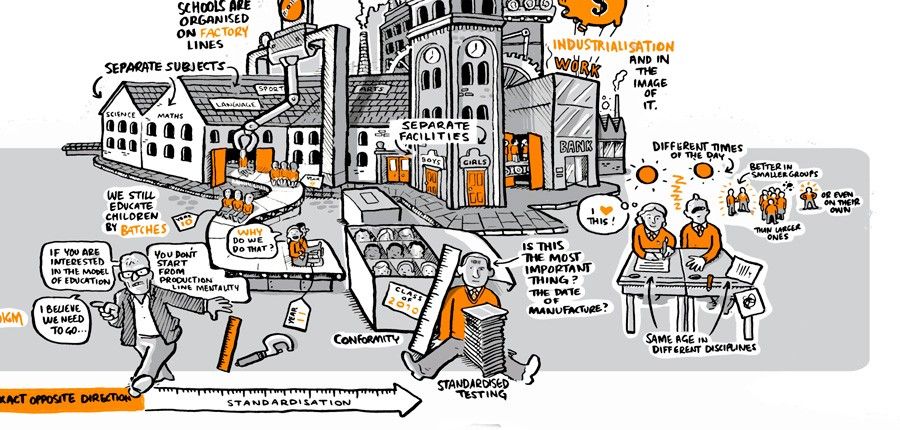
A link to his remarkable 2006 RSA speech.
"Every country on earth is trying to figure out how do we educate our children so they have a sense of cultural identity so that we can pass on the cultural genes of our communities while being part of the process of globalisation? How do we square that circle? The problem is they're trying to meet the future by doing what they did in the past. And on the way they're alienating millions of kids who don't see any purpose in going to school. ..."
The video link is below; HERE is a link to the transcript.
Possible Futures Today: Secondary Education
-
INTRODUCTION
Possible Futures Today: Secondary Education
Click on individual tabs to go to the content.
-
XP School, Doncaster - CREW
XP School, Doncaster
CREW
-
XP School, Doncaster - EXPEDITIONS
-
MICHAEL MOORE: Why Finland Has The Best Education
 Michael Moore wanted to find out why Finnish schools were at the top of the PISA tables and the USA was near the bottom. This film is full of answers to that question. Here are a few of them.
There is no homework. As one teacher says, ‘The whole term “homework” is obsolete.’ A group of teenagers is asked how much homework they do in a day. The answers vary from twenty minutes to no time at all.
Younger children spend only twenty hours a week in school. Finland has shorter school days and shorter school terms than anywhere else in the world. One teacher declares that if you constantly get just work, work, work, then you stop learning..
In Finland it is against the law to set up a school and charge tuition. That means that the rich kids have to go to the same kind of school as everyone else, and their parents make sure that all schools are good. Michael Moore comments that in the USA they have stopped teaching art, music and poetry. To the shocked Finnish reaction, he gives the standard American response. ‘We got rid of poetry. How does poetry help you to get a job?’
One of the teachers interviewed remarks that what he teaches is how to be happy. ‘And you’re a math teacher?’ says Michael Moore, incredulously. ‘Yes,’ the teacher replies. ‘School should be about finding a way to learn what makes you happy.’ Watching this film might make you happy.
source:
https://www.libed.org.uk/index.php/reviews/554-why-finland-has-the-best-education
-
Leading Contemporary International Policies
A Trans-national Selection of National/State/International Contemporary Early Childhood Education founded on principles of children’s rights and capacities. (2022)
Each submitted item needs:
- A very short intro (1 – 2 sentences);
- A pdf if article, or link to a video or longer article;
- Ideally an image.
Email your content proposals to
